
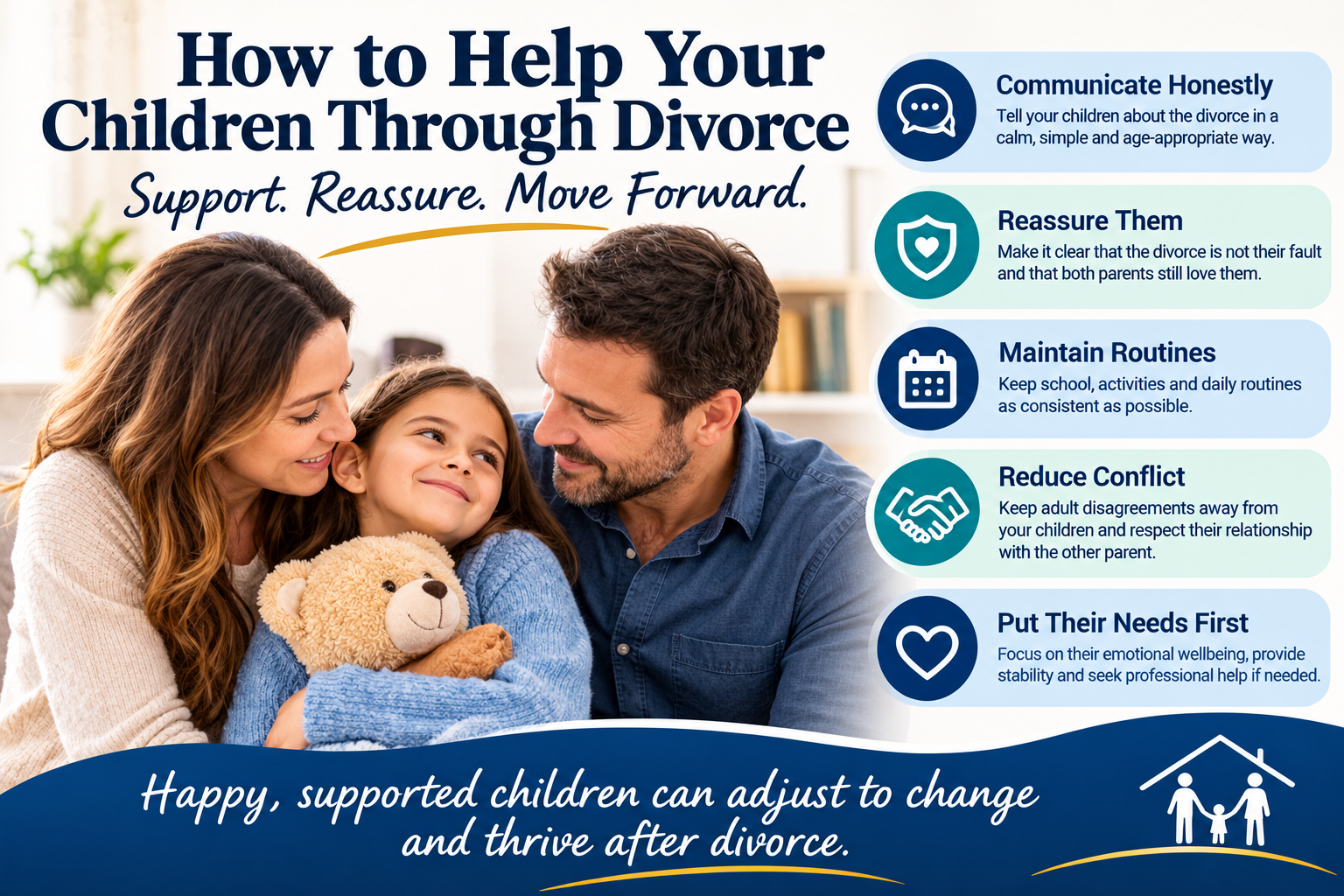
Divorce is one of the most difficult transitions a family can experience. While parents may be dealing with grief, anger, uncertainty and practical changes, their children are also trying to understand what is happening and what it means for their future.
Children may worry about where they will live, whether they will have to change schools, when they will see each parent, or whether their parents will stop loving them. Some children express their feelings openly, while others become withdrawn, anxious, angry or unusually quiet.
Although parents cannot remove every difficulty associated with divorce, they can do a great deal to help their children feel safe, loved and supported.
The most important principle is to put your children’s needs first, protect them from parental conflict and reassure them that they are not responsible for the divorce.
1. How should you tell your children about the divorce?
Where it is safe and appropriate to do so, parents should try to tell their children together. Choose a calm time when you can speak without interruption and answer questions honestly.
Avoid telling children too far in advance if there is no practical reason to do so, but give them enough time to understand and prepare for changes that will affect them. The timing should take their ages, circumstances and immediate needs into account.
When explaining the decision:
-
Keep the explanation simple and age-appropriate. Children do not need to hear the intimate details of the relationship or the reasons for every disagreement.
-
Avoid blaming the other parent. Do not use the conversation to criticise your spouse or justify your own position.
-
Reassure them that the divorce is not their fault. Children may believe that something they said or did caused the separation.
-
Make it clear that both parents still love them. Explain that the relationship between the adults is changing, but the children remain important to both parents.
-
Explain what is known about the practical arrangements. Tell them where they will live, what will happen with school and when they are likely to spend time with each parent.
-
Allow questions and emotions. Children may need to hear the same reassurance more than once, and they may not be ready to discuss everything immediately.
You could say:
“Mum and Dad have decided that we will no longer live together as a couple. This is an adult decision, and it is not your fault. We both love you very much. We will explain what is going to change and make sure you know what to expect.”
Do not promise arrangements that have not yet been agreed. It is better to explain honestly what is still being worked out than to give a child false certainty.
2. Help your children feel secure during the transition
Children often find uncertainty particularly difficult. They may want to know where they will sleep, who will collect them from school, whether they can continue seeing their friends and what will happen during holidays and birthdays.
Where possible, maintain familiar routines, including school attendance, extracurricular activities, friendships, bedtime routines and relationships with extended family.
When changes are unavoidable, explain them calmly and give children as much notice as reasonably possible.
Try to avoid making several major changes at once unless circumstances require it. A move to a new home, a school change and significant changes to contact arrangements can be overwhelming when they happen together.
Above all, children need to know that the adults responsible for them will continue to provide care, structure and reassurance.
3. Protect your children from parental conflict
One of the most helpful things parents can do during and after divorce is to reduce their children’s exposure to conflict.
Disagreements about money, property, maintenance, parenting arrangements or the history of the relationship should not become the children’s burden. Children should not be expected to choose sides or manage their parents’ emotions.
To reduce conflict:
-
Do not criticise the other parent in front of your children. Children should be free to love both parents without feeling disloyal to either.
-
Never use your children as messengers. Communicate directly with the other parent about practical arrangements.
-
Keep handovers calm and predictable. Confirm collection times, arrive punctually and have the children’s belongings ready.
-
Communicate respectfully and clearly. Where face-to-face communication is difficult, consider written communication focused on the children’s needs.
-
Respect each parent’s time with the children. Avoid unnecessary interruptions, interrogations or attempts to control the other parent’s parenting time.
-
Keep adult disputes between adults. Do not discuss court proceedings, financial allegations or settlement negotiations with children.
-
Do not ask children to report on the other parent. They should not feel responsible for monitoring what happens in the other household.
If communication repeatedly becomes hostile, a structured communication arrangement or help from a suitable professional may be useful. Where there is intimidation, abuse or a safety concern, communication and handover arrangements should be planned with appropriate safeguards.
4. Respect your child’s relationship with both parents
Where it is safe and in the child’s best interests, children generally benefit from being able to maintain meaningful relationships with both parents.
A child should not feel guilty for enjoying time with the other parent, speaking affectionately about them or wanting to maintain contact with their extended family.
Avoid asking questions that make a child feel they must choose between parents. Instead of asking, “Did you have more fun with your father than with me?”, try, “I’m glad you enjoyed your time. Is there anything you would like to tell me about it?”
It is equally important not to force a child to express affection or dismiss genuine concerns. If a child resists contact or appears frightened or distressed, listen carefully and seek appropriate professional advice. The reasons for the child’s response need to be understood rather than automatically attributed to one parent.
A child’s relationship with each parent should be supported in a way that prioritises safety, emotional wellbeing and the child’s individual needs.
5. Understand your child’s feelings at different ages
Children experience divorce differently depending on their age, temperament, developmental stage and family circumstances.
Babies and toddlers
Very young children may not understand the meaning of divorce, but they can respond to changes in routine, separation from a familiar caregiver and tension in the home.
Consistent care, familiar routines, calm transitions and reassurance from trusted caregivers can help them feel secure.
Preschool children
Young children may engage in magical thinking and believe that their behaviour caused the separation. They may become clingy, have sleep difficulties or return to behaviours they had outgrown.
Reassure them repeatedly that the divorce is not their fault. Use simple explanations and predictable routines.
School-age children
Children of school-going age may feel sad, angry, embarrassed or worried about how the divorce will affect their lives. They may hope their parents will reconcile or believe they must solve the problem.
Listen without judgement, answer questions honestly and make it clear that adult relationship problems are not theirs to fix.
Teenagers
Teenagers may respond with anger, withdrawal, anxiety or apparent indifference. They may also be concerned about practical responsibilities, finances or changes to their independence.
Respect their growing need for privacy while remaining available and emotionally present. Do not rely on a teenager to provide emotional support to a parent or take responsibility for younger siblings because of the separation.
These are general patterns, not fixed rules. If your child’s distress is persistent, severe or interfering with daily life, consider seeking help from a suitably qualified child psychologist, counsellor or other appropriate professional.
6. Keep communication with your children open
Children do not always tell their parents when they are struggling. Some fear upsetting a parent, while others do not have the words to describe their feelings.
Make space for regular, relaxed conversations. Listen before offering solutions, acknowledge their feelings and avoid dismissing their concerns.
You might say:
-
“It is okay to feel sad or angry.”
-
“You can talk to me about anything.”
-
“You do not have to choose between Mum and Dad.”
-
“It is not your job to fix things between us.”
-
“If something worries you, we will listen and try to help.”
Do not pressure children to talk before they are ready. Sometimes a quiet conversation during a walk, a car journey or an ordinary family activity is easier than a formal discussion.
7. Why a parenting plan can help
In South Africa, a parenting plan can help separated or divorced parents establish clear, practical arrangements for their children.
Depending on the family’s circumstances, it may address:
-
Where the children will live and how care will be shared.
-
Contact and communication with each parent.
-
Schooling, healthcare and extracurricular activities.
-
School holidays, birthdays and special occasions.
-
Transport and handover arrangements.
-
Communication between parents and the sharing of important information.
-
How disagreements about parenting will be addressed in future.
A parenting plan can reduce uncertainty by setting out expectations and providing a framework for decision-making. It cannot eliminate every disagreement, but clear arrangements can reduce opportunities for unnecessary conflict.
Under South African law, parenting plans are addressed in section 33 of the Children’s Act 38 of 2005. The appropriate process for preparing, registering or making a parenting plan an order of court depends on the circumstances and the applicable legal requirements.
A parenting plan should be tailored to the individual child and family. It should not be treated as a rigid formula or used to prioritise one parent’s preferences over the child’s best interests.
8. How divorce mediation can help parents
Divorce mediation gives parents an opportunity to work through practical arrangements with the assistance of an impartial mediator.
Rather than allowing every disagreement to become a prolonged dispute, mediation can help parents identify their children’s needs, clarify areas of disagreement and explore workable solutions.
Depending on the circumstances, mediation may assist with:
-
Parenting plans and care arrangements.
-
Contact schedules and holiday arrangements.
-
Communication between parents.
-
Decision-making about education and healthcare.
-
Resolving disagreements before they escalate.
Mediation is not suitable for every situation. Where there is domestic violence, coercive control, intimidation or a significant imbalance of power, careful screening and appropriate safeguards are essential. Alternative processes or court intervention may be necessary.
The purpose is not to make parents remain friends. It is to help them make informed decisions about their children and, where possible, establish a more workable co-parenting relationship.
9. What does South African law say about children and divorce?
The best interests of the child are paramount in matters concerning the care, protection and well-being of children. Section 28(2) of the Constitution of the Republic of South Africa, 1996, and section 9 of the Children’s Act 38 of 2005 are important provisions in this regard.
This means that decisions about care, contact and parenting arrangements must focus on the particular child’s circumstances and needs.
There is no automatic rule that children must spend exactly half their time with each parent. Equally, a child’s relationship with one parent should not be disregarded without considering the relevant circumstances. The appropriate arrangements depend on factors such as the child’s safety, age, developmental needs, existing relationships, routine and the ability of the arrangements to serve the child’s best interests.
Children’s views should also be considered in an age- and maturity-appropriate manner, in accordance with the applicable law. Listening to a child does not mean making the child responsible for deciding the dispute.
Where parents cannot agree, they may need assistance from a mediator, relevant professionals or the court.
10. When should you seek professional help?
Consider professional support if your child shows ongoing distress, marked changes in behaviour, persistent sleep problems, school difficulties, withdrawal or anxiety that affects everyday life.
A child psychologist, counsellor or other suitably qualified professional can help assess the child’s needs and provide appropriate support.
If a child discloses abuse, expresses fear about contact, or there are concerns about immediate safety, take those concerns seriously and seek appropriate professional or legal assistance. Do not assume that every reluctance to see a parent is manipulation, and do not assume that every concern is proof of abuse. The circumstances must be assessed carefully.
Parents may also benefit from support for themselves. Managing grief and anger with the help of trusted adults or professionals can make it easier to respond calmly to children.
Frequently asked questions
How can I make divorce easier for my children?
You cannot remove every difficult feeling, but you can provide reassurance, maintain routines, communicate honestly and protect children from adult conflict. Where safe and appropriate, support their relationships with both parents.
Should parents tell children about divorce together?
Where it is safe and practical, a joint conversation can help children understand that both parents are communicating important information. However, this is not appropriate in every family, particularly where abuse, intimidation or safety concerns exist.
Should children decide which parent they want to live with?
Children’s views should be heard and considered in an age- and maturity-appropriate way. They should not be placed under pressure to choose a parent or made responsible for resolving the dispute. Decisions must be guided by their best interests.
Can mediation help us agree on a parenting plan?
Yes. Where mediation is appropriate, it can help parents discuss care, contact, holidays, communication and future decision-making. Mediation should be screened for suitability, particularly where there are safety concerns or a power imbalance.
What if my child refuses to see the other parent?
Listen calmly and try to understand the reasons for the refusal. Do not dismiss the child’s feelings or immediately assume that the other parent has caused them. Depending on the circumstances, professional assessment, legal advice or court intervention may be appropriate.
Helping your children move forward
Divorce changes the structure of a family, but it does not have to destroy a child’s sense of security or belonging.
Children need parents who are willing to put their needs ahead of adult disagreements, communicate responsibly and make practical arrangements that reflect the realities of family life.
You do not have to agree on everything to be effective co-parents. By reducing conflict, providing stability and focusing on your children’s best interests, you can help them adjust to the changes and move forward with greater confidence.
If you are going through a divorce and need assistance with parenting arrangements, a parenting plan or divorce mediation, professional guidance can help you explore an approach suited to your family’s circumstances.
Van Rooyen Attorneys & Mediators provides family law and mediation services in Randburg and surrounding areas.
